
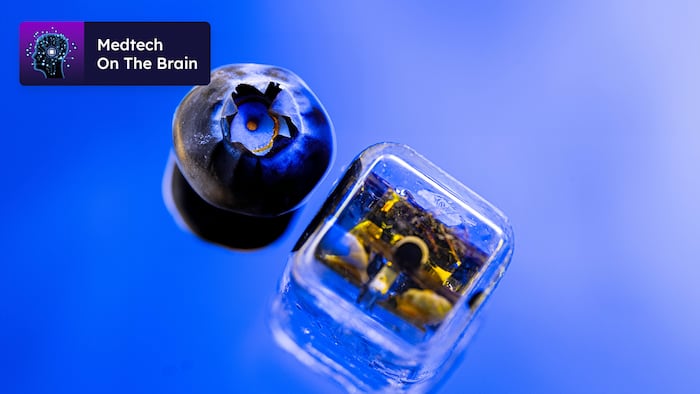
Medtech Insight is honoring May and June awareness months for mental health, Alzheimer’s and brain health by speaking with industry leaders about rising innovations to address neurological diseases and mental health, the regulatory and investment climate, reimbursement, and more.
Motif Neurotech CEO Jacob Robinson envisions a future where tiny, minimally invasive bioelectronic devices serve as general purpose therapeutic brain-computer interfaces (BCI) to treat depression and other mental health conditions and detect signals allowing for early intervention.
Much of the buzz surrounding BCI has centered on companies such as Elon Musk’s Neuralink Corp., which announced first implantation of its BCI in a human in February 2024. As of April, the quadriplegic patient was playing online chess and other games via what Neuralink calls “telepathy.”
Synchron, Inc., Paradromics, Inc., and Blackrock Neurotech are pursuing similar BCI applications to restore autonomy to severely motor-impaired individuals by enabling them to control digital devices using just their thoughts.
Key Takeaways
-
Motif is taking aim at a gap in the market for brain-computer interfaces that treat neurological disorders.
-
In a recent study, the company’s pea-sized, wireless, battery-free implant – which does not actually touch the brain – was shown to be powerful enough to stimulate movement in a patient’s hand.
-
While comparable to transcranial magnetic stimulation, Motif’s depression solution promises significant cost savings and convenience, as it can be used with a tech-infused hat to receive doses of at-home therapy as agreed with a patient’s psychiatrist.
Motif’s CEO and co-founder Jacob Robinson, a bioengineer at Rice University, believes BCI devices could be disruptive in another field, psychiatry.
“As I watched the other companies form and mature, I realized there was a whole segment of the population that was suffering from neurological disorders that would not necessarily be best addressed by those technologies,” Robinson told Medtech Insight.
“What we were missing were therapeutic brain-computer interfaces [for] the whole segment of the population that are suffering from mental health conditions,” he said.
Robinson explained that for every person with a spinal cord injury, there are 10 people suffering from major depressive disorder and not responding to drugs – “an absolutely massive market.”
It was in Robinson’s laboratory at Rice University that he and his team first developed the general-purpose therapeutic BCI technology that would undergird Motif. Robinson co-founded Motif in April 2022 with fellow professor Kaiyuan Yang and clinicians Sameer Sheth and Sunil Sheth.
The primary function of Motif’s “pea-sized” (9 mm x 9 mm x 11 mm) brain stimulator, or Digitally programmable Over-brain Therapeutic (DOT), is to “change the patterns of electrical activity inside the brain that give rise to mental health disorders like depression.”
Per Robinson, “One thing we’ve learned over the last several decades in neuroscience is that these aberrant patterns of activity is what underlies this disease.”
Small But Mighty
What sets Motif apart from companies like Neuralink, Paradromics and Precision Neurotech is that the device is much less invasive, which makes it less risky. He explained that because mood disorders are slowly changing, the amount of bandwidth, or information, that needs to be captured from the brain is far less than what’s needed to decode speech or move a mouse. Motif’s device only penetrates the skull whereas the other devices have electrodes that go much deeper into the brain, he said. The fact that it never touches the brain, reduces risk of damage or rejection.
Neuralink, comprising a chip and electrode “thread” arrays, must be implanted in the cerebral cortex by the company’s own surgical robot.
Motif’s implant, on the other hand, is placed atop the dura via a typical neurosurgical burr hole procedure, requiring just 20 minutes, the company says.
Motif harnesses recent advances in magnetoelectric wireless power transfer that enable its miniaturized, battery-free device to produce sufficient energy to stimulate cortical activity on-demand through the dura.
In April, Motif reported study results in Science Advances showing that despite being much less invasive, its DOT is powerful enough to stimulate movement in a patient’s hand, comparable to what is seen in transcranial magnetic stimulation (TMS). The researchers also showed that the device could stimulate movement in a forelimb for 30 days in pigs. (Also see "‘If It Wasn’t For NeuroStar, I Wouldn’t Be Here Today,’ Says Teen Patient" - Medtech Insight, 16 May, 2024.)
Relief At The Drop Of A Hat
Researchers have found that in people with major depressive disorder (MDD), several areas of the brain show activity changes. One key region shown to be over-active in people with MDD is the anterior cingulate cortex, a mood processing center, while an area shown to be under-active in this population is the prefrontal cortex, associated with executive function, that helps people initiate activities such as getting out of bed, taking a shower and going to work.

Many people with MDD have reduced ability to initiate those tasks. TMS is the current standard used to treat MDD non-invasively by stimulating the executive function region of the brain to help people perform these daily activities.
But Robinson noted the effects typically do not endure beyond one year. Further, a single dose of TMS costs insurers $12,000, and patients are required to report to the clinic five days a week for six weeks, another heavy expense.
Contrast that with Motif’s device, which uses “a million times less power than a TMS machine” and can be activated by the patient at home, as prescribed, with a wearable. This could be a baseball cap embedded with a magnetic coil and driver system to power and communicate with the implant. Robinson likened the technology to a power mat that is built into the cap and pairs with the implant.
“We know that this therapy can be effective in as little as 20 minutes a day, so you only need to wear the hat when you’re receiving the therapy,” he explained. A physician would program the dose of therapy and the patient would use a smartphone to choose when they receive the prescribed dose and to monitor their brain health.
With the hat off, the implant would be inactive and invisible. Robinson expects the implant could last for 10 years or even longer.
There are instances when the device would need to be explanted, such as when a patient undergoes a magnetic resonance imaging (MRI) exam. “If you needed to get a scan close to where that implant is, it can be explanted in about a 20-minute procedure in the same way that implanting also takes about 20 minutes,” Robinson said.
Path To Market
The next step for Motif is to evaluate the design concept with respect to device safety and functionality in animals, before moving to human testing. Pending the successful completion of these animal trials, Robinson expects to test the device in humans.
“We have had conversation with the FDA (US Food and Drug Administration) about our clinical plan and we’re on target to begin the clinical trials [in humans] within two years,” he said. “We expect our primary endpoint to be, within five weeks of implantation at which time we expect to see people respond to the therapy.”
“The other advantage that we have that will be likely disruptive to psychiatry is the fact that with a device you have the opportunity to record brain activity, and by recording brain activity you can develop biomarkers that indicate some of the progress toward remission and risk of relapse.” – Jacob Robinson
Pending clinical trial success and FDA premarket authorization, Motif could be ready for commercialization in six years, Robinson said.
To date, Motif has raised over $20m in venture capital funding, which, Robinson said, will be enough to fund first human trials.
Competition is on the rise. In 2022, San Francisco-based Inner Cosmos received FDA investigational device exemption approval to conduct first human trials in people with depression using its stimulation device, described as a “digital pill” or “penny-sized device slipped under the skin [that] rebalances brain networks using imperceptible micro-stimulation.”
Inner Cosmos’ first mission is “to heal the largest chronic disorder in the world, depression.”
The company’s CEO, Meron Gribetz, told VentureBeat.com recently that early human trials yielded encouraging results regarding safety and efficacy.
Asked about what makes Inner Cosmos’ device different, Robinson explained that Motif’s use of magnetoelectric power transfer technology allows it to make a device that is about two times smaller in diameter. In addition, he noted that “Motif is the first to show human data using a prototype miniature stimulator.”
Treating Depression Like Heart Disease
Regarding depression, Robinson noted, “These are biological disorders in the same way as heart arrythmia is a biological disorder.”
Motif’s CEO envisions that mental health issues in the future will be treated much like heart disease today with a combination of drugs and devices.
“If you can lower the dose on drugs, augment with devices and potentially talk therapy, you create better outcomes,” he said.
He added, “The other advantage that we have that will be likely disruptive to psychiatry is the fact that with a device you have the opportunity to record brain activity, and by recording brain activity you can develop biomarkers that indicate some of the progress toward remission and risk of relapse.”
By monitoring a patient and looking at continuous data, psychiatrists could be empowered to intervene before symptoms get worse, potentially heading off a mental health crisis.
“I think of it as a Fitbit for your mental health,” Robinson said.